When a silo stops discharging properly, the problem rarely stays inside the silo. Production slows or stops, product is wasted, and someone on site is usually tempted to “just have a look”. This guide covers how to spot the warning signs, how a blocked silo should be emptied safely, and why the best time to inspect and repair a silo is straight after it has been evacuated and cleaned.
Silo evacuation, cleaning and repairs are often treated as separate jobs. They work best as one: evacuation gets the product out, cleaning restores capacity and hygiene, and inspection finds the damage or defect that caused the problem in the first place.
Signs your silo needs attention
Most silo problems give some warning before they stop production. Look out for:
- Erratic or reduced discharge. Flow that surges and stops, or batches that take longer than usual to fill.
- Bridging. Product forms an arch over the outlet and nothing comes out, even though the silo is far from empty.
- Rat-holing. Product flows down a narrow channel in the centre while the rest stays stuck to the walls, so your usable capacity quietly shrinks.
- Lumps or discoloured product downstream. Often a sign of old, damp material breaking away from the walls.
- Level readings that don’t add up with what has been delivered and used.
- Visible damage such as rust, cracked concrete, leaking seals, damaged filters, or product escaping from the roof or airlines.
Why silos block
Build up and bridging usually come down to a combination of the material, moisture and time.
Hygroscopic products such as sugar, flour and animal feed absorb moisture and bond together. Condensation is a particular issue in the UK in autumn and winter, when mild days and cold nights cause moisture to form on the inside of silo walls. That’s why seasonal changes should shape your cleaning schedule. Product that sits too long, or a silo that is never fully emptied, gives residue time to harden, and poor outlet design, damaged aeration and worn liners all make it worse. Our tips for preventing blocked silos cover the day-to-day side of this.
What not to do when a silo is blocked
A blocked silo puts pressure on everyone to clear it quickly, and that is when the most dangerous decisions get made. HSE’s confined spaces guidance lists silos as confined spaces and warns that free flowing solids such as grain “can also partially solidify or ‘bridge’ in silos, causing blockages which can collapse unexpectedly”. Anyone standing on or under that product can be engulfed.
The Confined Spaces Regulations 1997 require you to avoid entry where the work can be done from outside, follow a safe system of work where entry can’t be avoided, and have emergency rescue arrangements in place before work starts. In practice, that means:
- Don’t send staff into the silo to break up product or “walk it down”.
- Don’t try to break a bridge from underneath the outlet.
- Avoid repeatedly hammering the silo wall. It rarely shifts a bridge and can dent or distort steel silos.
- Don’t keep running discharge equipment against a blockage, as this can damage screws, valves and motors.
Isolate the silo, keep people clear and call in a team trained in confined space entry and rescue. Our article on cleaning confined spaces safely explains the wider risks.
How silo evacuation works
Every evacuation starts with a survey and risk assessment: what is stored, how much is left, how hard it has set, where the access points are and whether the product can be saved. From there, the method depends on the silo.
Remote break-up
The Giro Whip system is lowered through the roof hatch and operated from outside the silo. Its rotating head and cutters break up hardened product and bridges on the walls without anyone going inside, and it can reach well over 50 metres. Where roof access is difficult, we use truck mounted access platforms.
Vacuum extraction
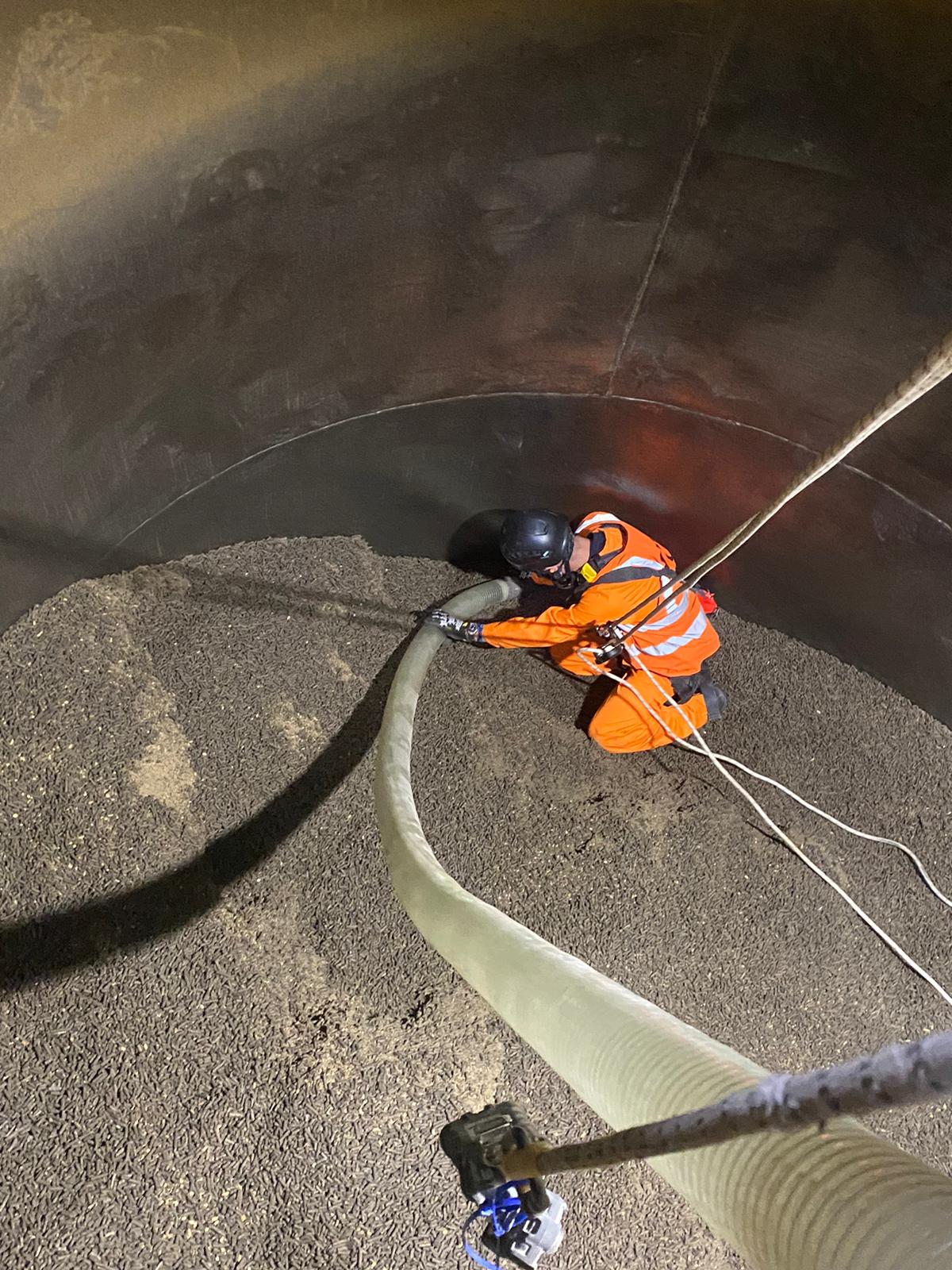
Once the material is moving, vacuum extraction using DISAB vacuum tankers removes it from the silo, cone and pipework. Product can be fed through a hopper bagging unit into bulk bags on site, so recoverable material isn’t wasted and the rest can be disposed of correctly.
To give an idea of scale, on one flour silo at a major UK bakery we removed around 13 tonnes of hardened product, filling 28 bulk bags. In an animal feed silo, around two tonnes had set in the cone and was blocking the screw below.
Cleaning the empty silo
Getting the product out restores flow. Cleaning stops the problem coming straight back and deals with the hygiene risk. Depending on the material, this can include a dry clean and brush down of the walls, roof underside and cone, steam cleaning, and cleaning of filters, dust collection housings and intake and discharge pipework.
For food manufacturers, the paperwork matters as much as the clean. Auditors expect evidence, so every ACS silo clean comes with a detailed report, photographs, swab test analysis and a hygiene certificate. Our guide to silo cleaning regulations for food manufacturers explains what auditors look for.
Inspect and repair while the silo is empty
An evacuated, clean silo is the best chance you will get to see its true condition, and it saves paying for a second shutdown later. A thorough inspection covers:
- Corrosion, rust and pitting on steel walls, seams and the cone
- Cracks, spalling or exposed reinforcement in concrete silos
- Dents, distortion and wear on walls and liners
- Roof hatches, seals and gaskets that could let water in
- Filters, explosion panels and pressure relief
- Valves, airlines, aeration pads and discharge equipment
Small defects can cause big problems. During an external silo inspection at a UK bakery, we found airline valves split in around 20 places, which had left roughly six inches of flour across the top of the silos.
Our silo repair and maintenance team works on steel, concrete and composite silos, from repairs and resealing to steam cleaning, sanitisation and repainting.
Plan ahead with a silo maintenance schedule
Emergency call-outs cost more than planned work, both in fees and in lost production. A simple schedule makes a big difference:
- Set risk-based cleaning intervals. For most food, feed and industrial silos we recommend every 6 to 12 months, and more often for moisture-sensitive or allergen-containing products.
- Combine cleaning with inspection so every shutdown doubles as a condition check.
- Book around planned shutdowns. Many sites use the Christmas and New Year shutdown for silo work, so it’s worth booking early.
- Keep records of every clean, inspection and repair, ready for your next audit.
- Act on the early warning signs above before they turn into a full blockage.
Frequently asked questions
Is silo cleaning confined space work?
Yes. HSE names silos as an example of a confined space, so work inside one falls under the Confined Spaces Regulations 1997. Our technicians are City and Guilds confined space and rescue trained, and we use remote methods to avoid entry wherever possible.
Can the product in a blocked silo be saved?
Often, yes. Free-flowing product above a bridge can usually be recovered and bagged. Hardened, damp or contaminated material normally has to be disposed of. We’ll assess this during the survey.
How long does silo evacuation take?
It depends on the size of the silo, the material, how hard it has set and how easy it is to access. We’ll give you a realistic timescale after the site survey.
Do you cover the whole UK?
Yes. We carry out silo cleaning, evacuation and repairs across England, Scotland and Wales, including emergency call-outs.
Talk to ACS about your silos
Whether you have a blocked silo now or want to plan next year’s maintenance, ACS Specialist Cleaning has over 25 years’ experience and is ISO 9001 and ISO 45001 certified. Call 0800 774 7750, email info@acscleaningltd.co.uk or request a free quote or site survey.